
 STUDIO POLICIES
2025-2026
Student Age Private piano lessons are available to students ages 7 and up.
Piano Lesson Information Piano lessons are weekly or bi-weekly private sessions lasting 30, 45, or 60 minutes depending on your choice and level of study. Each piano lesson covers all areas of musicianship: sight reading, ear training, studying repertoire, music history, composition, theory, technique, and performance. Lessons are offered year-round and continue as usual during the summer months. Much progress is lost when students do not continue lessons throughout the summer. If you wish to take a leave of absence during the summer, please be aware your same time slot cannot be guaranteed. In addition, my teaching schedule may well be filled upon your return. The studio operates year-round at full capacity.
Location Piano lessons are available online or at my studio convenient for Hendersonville, Gallatin, Rivergate, Madison, Goodlettsville, White House and some Nashville areas. Piano lessons can also be taught, for your convenience, in your home if time slots can be arranged around my studio teaching schedule. If piano lessons are taught in your home, please have available a well-tuned piano or keyboard with weighted, touch-sensitive keys and a sustain pedal. A reasonable surcharge will be added to the lesson rate based on travel time and distance.
Styles of Music A variety of different music styles may be studied, including classical, jazz, popular, and sacred depending on the student's goals and abilities.
Method Books Used A broad selection of sheet music and instructional method books including Faber, Alfred, Glover, and Bastien is used to motivate, educate, and meet each individual student's interest and level.
Supplies Students should come to every class prepared with all necessary materials (practiced assignments, completed theory, all music books, assignment notebook, and book bag). Method books and sheet music will need to be purchased on occasion throughout the year. These are not included in lesson fees. They are purchased by the teacher and billed to the student to be paid when the next payment is due.
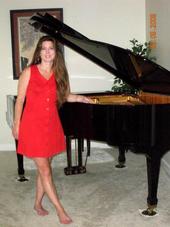
Tuition Rates Please contact me for a current fee schedule. Each school age student pays a yearly registration fee due with October tuition or at the time of enrollment for new students. This non-refundable deposit guarantees your child’s lesson time in the studio teaching schedule and also helps with direct student costs associated with ensuring high quality education. A few of these costs include learning aids, incentive programs, prizes, rewards, special activities, subscription costs of music software used by students, photocopies, group lessons, upkeep of the studio grand piano, etc.
Payment of Fees Tuition is payable in advance for the entire month due the first lesson of each month. Please be aware of the months having 5 weeks. A $10.00 late fee will be charged to all accounts not paid in full by the 10th of the month. There will be a $25.00 charge for any checks that are returned. Should there be a second occurrence, future payments must be made in cash.
Missed Lessons Pamela Piersyn Music Studio operates at full capacity and make-up times for missed lessons are next to impossible. Therefore, only one make-up lesson can be allowed per semester (fall/spring) and will be arranged at the end of the current term. As in a private school or university environment, fall and spring tuition is based on enrollment, not attendance. Please understand payment reserves an exclusive weekly specified lesson time throughout the year for your child and NO refunds, deductions, or credits can be given for missed lessons. That time cannot be resold nor can extra teaching time be created in which to give lessons. Lessons missed by the teacher will definitely be made up. Because of more available teaching hours during the summer term, missed lessons can be rescheduled.
Recitals Periodic recitals will be held as a celebration of learning. Participation is encouraged for all students through high school age. Performing for a live audience enhances the student's excitement and joy of playing.
Piano vs. Keyboard All students must have a piano or digital piano (keyboard) for home practice. The quality of your student’s home instrument plays a significant role in his/her potential for success. A well-tuned (at least once a year) acoustic piano is best for practice and performance. The vibrations that come through an acoustic piano's strings as the student plays are addicting and heighten the enjoyment of playing. A keyboard will have a very different feel and sound in comparison. However, if you prefer to begin on a digital piano, please invest in one with at least 76 (preferably 88) weighted, touch-sensitive keys and a pedal.
STUDIO REGULATIONS
* Please remember, the piano studio is part of my private residence, and must always be regarded and respected as such. Please do your part to maintain the premises for the sanctity of my home.
* If a lesson is still in progress upon your arrival, please do not ring the doorbell so as not to disturb the teaching session; but feel free to come on in and have a seat in the waiting area.
* No unattended children are allowed in the music studio or outdoors. Please help me keep the learning environment quiet and free from distractions.
* If property is damaged, parents shall be responsible for reimbursement.
* Students should arrive on time and be picked up promptly. Lessons cannot be extended beyond the scheduled class time for students who arrive late.
* Students should come to class prepared with all necessary materials (practiced assignments, completed theory, all music books, assignment notebook, and book bag).
* Rings and bracelets should not be worn during the lesson.
* Nails should be maintained short enough where they do not click or slide on the keys. This will allow for the development of the optimal hand position.
* Students are evaluated at the end of each quarter. If progress proves unsatisfactory, a parent/teacher conference will be scheduled.
* No food, drinks, candy, or gum are permitted in the music studio.
TIPS TO PARENTS
* Establish a daily practice routine.
* Aim for a five-day practice week.
* Beginning students should practice 20 minutes a day for the first month, 30 minutes a day for the remainder of the year; intermediate students should practice 45 minutes a day and advanced students at least one hour a day.
* Organize practice sessions and keep practice free from interruptions (TV, radio, ipod, phone, etc.).
* Listen frequently to your child’s practice.
* Periodically reward your child for his/her music accomplishments.
The above policies are in place for the benefit of everyone in the studio and provide consistency and continuity in the course of lessons. When arrangements are made to study piano, these policies must be agreed upon by both the studio and the parents (or students, if adults). A signed copy will be retained for the studio.
***Reading and interpreting music is a language that develops much more than the obvious. Research proves music training specifically with piano/keyboard instruction enhances the development of children in many ways:
1. Higher test scores in math, reading, and science and improved SAT and IQ scores
2. Stronger analytical abilities and spatial-temporal performance
3. Better coordination, concentration, and confidence
4. Encourages listening and develops attention span
5. Helps develop gross and fine motor skills
6. Teaches discipline, care, perseverance
***Playing the piano requires the use of both hands, both eyes, both ears, both feet at times, ten fingers, and the brain all working to read notes, rhythm, fingering, and dynamics simultaneously!
.JPG)


